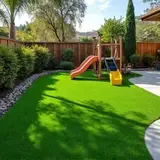
Playground turf in Phoenix is published as a safety surface before it is a lawn. The published surface is ASTM F1292 fall-rated and protects up to a 10-foot fall height, made of non-toxic material with no lead and no heavy metals, on a stay-cool fiber that reflects heat in desert conditions, and ADA accessible as a wheelchair-friendly surface. The published market bands are the same as any turf work - 8 to 15 per square foot installed, or 5 to 15 for a complete professional installation including removal, excavation, a crushed-rock base, turf and infill - because the source material publishes market-wide turf bands rather than a separate playground rate, and a play surface is specified and tested differently from a lawn. Published drainage is 30+ inches per hour, the base is open-graded stone compacted to 95% Standard Proctor, and a finished surface is published at 15-20 years with proper maintenance. Phoenix Artificial Turf is a free matching service, not a provider: we route your request to licensed local installers, we do not employ contractors, and we do not sell playground turf services.
What it costs in Mesa
| Job | Published 2026 range |
|---|---|
| Removal of the existing lawn and debris hauling, added to the installation | 1 - 3 per square foot |
| Excavation and a compacted crushed-rock base, added to the installation | 1 - 3 per square foot |
| Class II road base aggregate | $40 per ton |
| No. 57 clean washed angular stone | $48 per ton |
| Non-woven geotextile soil separator placed under the base | $0.45 per square foot |
| Basic turf with silica sand infill, per square foot installed | $4.00 per square foot |
| Rapid-drain turf with zeolite infill, per square foot installed | $6.00 per square foot |
| Standard installation labour | $5.50 per square foot |
| Pet-spec installation labour, deeper dig and edge pinning | $6.50 per square foot |
| Permit allowance, where the jurisdiction requires one | 100 - 500 |
| Spot repairs and small fixes | a few hundred to several thousand depending on scope |
What a playground turf installation actually involves
A play surface is specified around impact, not appearance, and the published description of the surface is short and specific: ASTM F1292 fall-rated, protecting up to a 10-foot fall height; non-toxic, with no lead and no heavy metals; stay-cool technology that reflects heat for desert conditions; and ADA accessible as a wheelchair-friendly surface. Everything underneath is published as being in service of those four properties.
| Element | Published description | What it decides |
|---|---|---|
| Infill | Infill spread between the blades at the manufacturer's published rate | Impact attenuation, and how the fiber stands up under play traffic |
| Turf surface | ASTM F1292 fall-rated surface, protecting up to a 10-foot fall height | The fall height the surface can be used under |
| Base | Open-graded angular stone, #57 or CA7, compacted in 2-inch lifts to 95% Standard Proctor | Uniform impact response; a soft spot is a fall risk, not just a wrinkle |
| Separator | Non-woven geotextile under the stone | Keeps native soil out of the drainage |
| Access route | ADA accessible, wheelchair-friendly surface | Whether the play area can be reached and used at all |
The published point about the base is that impact attenuation is a property of the whole build, not the carpet: an under-compacted or under-depth base produces exactly the soft spots the published diagnostic table warns about on any turf job, and on a play surface those spots are where the rating stops holding.
The published cost bands and how a play surface is quoted
The source material publishes market-wide turf bands rather than a playground-specific rate, and that is worth knowing before you compare quotes, because it means a playground number has to be built from the same published components as any other turf job.
| Scope | Published band |
|---|---|
| Complete professional installation, per square foot | 5 to 15 |
| Installed artificial turf in this market, per square foot | 8 to 15 |
| Removing an existing lawn and hauling debris, per square foot | 1 to 3 |
| Excavation plus a compacted crushed-rock base, per square foot | 1 to 3 |
| Basic turf material, per square foot | 2 to 4 |
| Premium high-face-weight turf material, per square foot | 4 to 8 |
| Typical 500-square-foot area, whole job | 4,000 - 7,500 |
| Whole-project band published for the market | 15,000 and 35,000 |
Three published cautions apply when a playground is quoted from these bands. The two published shapes disagree - a 500-square-foot area at 8 to 15 per square foot does not land near the 15,000 to 35,000 whole-project band - so ask which applies to your scope. A play surface uses premium high-face-weight fiber rather than the basic 2 to 4 material, which puts it at the upper end of the material line. And the published permit costs for this niche run 100-500, which a school, park or association project can add on top of a residential-shaped quote.
Why the Valley of the Sun is hard on a play surface
Two published conditions decide whether a play surface is usable rather than merely installed. The first is heat, and it is the sharper one for children: published surface temperatures reach 150 to 180 degrees in full sun, and the source material describes surface temperatures climbing past 140 degrees by early afternoon. The published mitigation is stay-cool fiber technology, which reflects UV and heat, plus water - on extreme triple-digit days a 30-second rinse with a garden hose is published as dropping the surface below the 110-degree threshold the source material uses for bare feet and paws.
The second is water. Phoenix is a 110 F-plus summer metro with an extreme-UV load and a storm-peaked monsoon. The NWS Phoenix forecast office publishes daily probability tiers for the metro at 100, 105, 110 and 120 F and keeps a running yearly count of Phoenix days at or above 110 F (https://www.weather.gov/psr/heat, HTTP 200), and the monsoon season runs through September 30, bringing the dust storms (wind gusts 40-60 mph) and thunderstorms NWS calls the most dangerous weather period of the Southwest year (https://www.weather.gov/psr/MonsoonSafety, HTTP 200). Sun load is the second half of the exposure: on EPA's UV Index scale everything at 8 and above is 'very high to extreme', where EPA advises extra protection even outside of peak hours (https://www.epa.gov/sunsafety/uv-index-scale-0, HTTP 200). The practical consequences for artificial turf are that shade and heat/UV tolerance drive the surface, infill and base specification rather than looks, and that the usable season inverts: roughly October through May is the comfortable season for installation and use, while June through September is the survival season for both people and finishes. A play area is a large, flat, hard-used surface with the stone base carrying the load, and the published specification for a high-use commercial-style surface is drainage of 30+ inches per hour, which is what keeps a surface usable after the heaviest rain of the season rather than closed for a day. The Salt River Valley floor is mapped almost entirely in hyperthermic, calcareous USDA-NRCS soils, and the local 'caliche' is a real mapped layer rather than a construction myth: the Pinal series (loamy, mixed, superactive, hyperthermic, shallow Typic Haplodurids) has a silica-lime indurated duripan - cemented hardpan - at roughly 12 to 18 inches in Maricopa County (https://soilseries.sc.egov.usda.gov/OSD_Docs/P/PINAL.html, HTTP 200), while Laveen Haplocalcids carry a calcic horizon from as shallow as 3 inches (https://soilseries.sc.egov.usda.gov/OSD_Docs/L/LAVEEN.html, HTTP 200) and Mohall Calciargids from 20 to 40 inches (https://soilseries.sc.egov.usda.gov/OSD_Docs/M/MOHALL.html, HTTP 200). For an artificial turf installation that means three things: base excavation and edge-restraint pins can stop on cemented hardpan well short of the intended depth; trenching an irrigation, drainage or low-voltage lighting run through a duripan or petrocalcic layer can require a breaker rather than a shovel; and because those layers slow water movement, grading, drainage and runoff detail matter more than the soil name on the map (check the specific lot with USDA-NRCS Web Soil Survey, https://websoilsurvey.nrcs.usda.gov/app/).
UV is the third published factor, and it is why the recommended turf is UV-resistant so it does not fade or degrade over time - a play surface takes that exposure across the whole area rather than in patches, and stay-cool fiber is the published technology for it.
Local note for Mesa
Mesa sampling (USDA-NRCS Soil Data Access) returns Laveen loam and Rillito gravelly loam; both are Typic Haplocalcids, and Laveen's calcic horizon ranges from just 3 inches to 34 inches deep (https://soilseries.sc.egov.usda.gov/OSD_Docs/L/LAVEEN.html, HTTP 200), while Rillito is somewhat excessively drained and gravelly (https://soilseries.sc.egov.usda.gov/OSD_Docs/R/RILLITO.html, HTTP 200). Gravelly, fast-draining ground is good for drainage and unforgiving for footings, so post bearing and backfill compaction should be checked rather than assumed.
Mesa Water Resources supplies the city from a mix of SRP and CAP surface water plus municipal wells - the city reports arsenic results for its 38 wells - and is explicit about the minerals in it: the city's own water-quality page states that Mesa water hardness ranges from 12 to 22 grains per gallon depending on which source serves your area (https://www.mesaaz.gov/Utilities/Water-Wastewater/Water-Quality/Common-Water-Quality-Concerns - HTTP 403 to our datacentre IP, i.e. bot protection on the correct city source). That is very hard water by any measure, which is why scaling, spotting and mineral film on hardscape, irrigation components and glass is the standard maintenance issue on Valley landscapes, and why softened water or a filter is often put on the irrigation line.
Utility accounts: City of Mesa Water Resources · 480-644-2221
Checking a quote in Mesa
- How deep will you excavate, and is that depth stated in the contract with the aggregate type?
- Which base material is specified - open-graded washed angular stone, or a dense-graded road base - and where does it come from?
- What compaction target do you build to, and how do you verify it before the turf goes down?
- Where will the drainage slope run on my lot, and how does water and dog urine leave the surface?
- Is the removal of the old lawn, the sprinkler capping and the debris disposal inside the quote or billed separately?
- What infill are you using, how many pounds per square foot, and is the seam and workmanship warranty separate from the turf manufacturer's warranty?
Frequently asked questions
How much does playground turf cost in Phoenix?
The source material publishes market-wide turf bands rather than a separate playground rate: 8 to 15 per square foot installed, or 5 to 15 per square foot for a complete professional installation including removal, excavation, base, turf and infill, with removal and hauling at 1 to 3 per square foot, excavation plus a compacted base at another 1 to 3, and turf material at 2 to 4 per square foot for basic fiber or 4 to 8 for premium high-face-weight fiber. A play surface uses the premium end, and published permit costs for this niche run 100-500. Get three quotes with an identical base scope.
What fall height is playground turf rated for?
The published playground turf in this niche is ASTM F1292 fall-rated and protects up to a 10-foot fall height. ASTM F1292 is the standard specification for impact attenuation of surfacing materials within the use zone of playground equipment, and it establishes a critical fall height for a surface. Ask for the rating in writing for the system proposed - turf, infill and base together - because the base and the infill are published as part of what attenuates impact, not just the surface fiber.
How hot does playground turf get in the sun?
Published surface temperatures reach 150 to 180 degrees in full sun, and the source material describes surface temperatures climbing past 140 degrees by early afternoon. The published mitigation is stay-cool fiber technology that reflects heat and UV, plus water: on extreme triple-digit days a 30-second rinse with a garden hose is published as dropping the surface below the 110-degree threshold the source material uses for bare feet and paws.