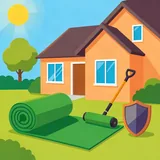
Residential artificial turf installation in Phoenix is published as a four-layer build - compacted base, drainage rock, the turf, and infill - and the published guidance is that roughly 90% of a turf system's success depends on what is hidden underneath it, with the visible grass described as the final 5 to 10% of the product. The published market bands are 8 to 15 per square foot installed, and 5 to 15 per square foot for a complete professional installation that includes removing the existing lawn, excavation, a crushed-rock base, the turf and the infill, with a typical 500-square-foot backyard published in the 4,000 - 7,500 range. The published build is open-graded angular stone, typically #57 crushed stone compacted in 2-inch lifts to 95% Standard Proctor, draining through roughly 40% open void space. A finished lawn is published at 15-20 years with proper maintenance, and many last even longer. Phoenix Artificial Turf is a free matching service, not a provider: we route your request to licensed local installers, we do not employ contractors, and we do not sell residential turf services.
What it costs in Tempe
| Job | Published 2026 range |
|---|---|
| Removal of the existing lawn and debris hauling, added to the installation | 1 - 3 per square foot |
| Excavation and a compacted crushed-rock base, added to the installation | 1 - 3 per square foot |
| Class II road base aggregate | $40 per ton |
| No. 57 clean washed angular stone | $48 per ton |
| Non-woven geotextile soil separator placed under the base | $0.45 per square foot |
| Basic turf with silica sand infill, per square foot installed | $4.00 per square foot |
| Rapid-drain turf with zeolite infill, per square foot installed | $6.00 per square foot |
| Standard installation labour | $5.50 per square foot |
| Pet-spec installation labour, deeper dig and edge pinning | $6.50 per square foot |
| Permit allowance, where the jurisdiction requires one | 100 - 500 |
| Spot repairs and small fixes | a few hundred to several thousand depending on scope |
What a residential turf installation actually involves
Artificial grass is the visible part of a system, and the published guidance is blunt about the rest: roughly 90% of a turf system's success depends on what is hidden underneath it, and the grass itself is described as the final 5 to 10% of the product. The published system is four layers - a compacted base, drainage rock, the turf, and infill - and the order of the layers is what decides how long the lawn holds its shape.
| Layer | Published description | What it decides |
|---|---|---|
| Subgrade | Native soil, excavated to a consistent depth and compacted | Load distribution; soft spots and sinkholes start here |
| Separator | High-flow non-woven geotextile, for example a 4 oz needle-punched separator | Stops native soil migrating upward and clogging the drainage |
| Base | Open-graded angular stone - #57 crushed stone (3/4-inch down to 1/4-inch, clean and washed) or CA7 clear gravel | Carries the load and drains; roughly 40% open void space once compacted |
| Bedding | 3/8-inch clean chip stone (ASTM #8 or High-Performance Bedding) | Smooths the surface so the turf is not laid over 3/4-inch stone |
| Turf and infill | Turf surface with silica sand or a coated infill | Feel, blade recovery and how long the surface keeps its shape |
Two published rules sit on top of that order. The fully compacted sub-base must sit exactly 1.5 inches below the top of the perimeter border or concrete curb, which is the pocket that lets turf and infill finish level with the edge; and a minimum 6-inch radius has to be left around trees, bushes and shrubs during excavation so root zones are not cut.
The published cost bands, per square foot and per job
The source material publishes two shapes for the same work - a per-square-foot rate and a whole-project band - and they answer different questions. Read them as scopes rather than averaging them into one number.
| Scope | Published band |
|---|---|
| Complete professional installation, per square foot | 5 to 15 |
| Installed artificial turf in this market, per square foot | 8 to 15 |
| Typical 500-square-foot backyard, whole job | 4,000 - 7,500 |
| Whole-project band published for the market | 15,000 and 35,000 |
The per-square-foot figures break down into published line items, which is the useful way to read a quote:
| Line item | Published cost per square foot |
|---|---|
| Removing an existing lawn and hauling the debris | 1 to 3 |
| Excavation plus a compacted crushed-rock base | 1 to 3 |
| Basic residential turf, material | 2 to 4 |
| Premium pet-grade or high-face-weight turf, material | 4 to 8 |
| Basic turf with a silica sand infill, material and infill combined | $4.00 |
The two published shapes disagree, and that matters: a 500-square-foot yard priced at 8 to 15 per square foot lands nowhere near the published 15,000 and 35,000 whole-project band. Ask which figure applies to the scope you are actually quoting rather than blending them. For comparison, the same material publishes xeriscape at 3 to 8 per square foot installed against turf at 8 to 15, and natural grass at 0.50 to 2 per square foot for seed or sod before any irrigation, mowing or fertilizer is counted.
Why the Valley of the Sun is hard on a synthetic lawn
Phoenix is a 110 F-plus summer metro with an extreme-UV load and a storm-peaked monsoon. The NWS Phoenix forecast office publishes daily probability tiers for the metro at 100, 105, 110 and 120 F and keeps a running yearly count of Phoenix days at or above 110 F (https://www.weather.gov/psr/heat, HTTP 200), and the monsoon season runs through September 30, bringing the dust storms (wind gusts 40-60 mph) and thunderstorms NWS calls the most dangerous weather period of the Southwest year (https://www.weather.gov/psr/MonsoonSafety, HTTP 200). Sun load is the second half of the exposure: on EPA's UV Index scale everything at 8 and above is 'very high to extreme', where EPA advises extra protection even outside of peak hours (https://www.epa.gov/sunsafety/uv-index-scale-0, HTTP 200). The practical consequences for artificial turf are that shade and heat/UV tolerance drive the surface, infill and base specification rather than looks, and that the usable season inverts: roughly October through May is the comfortable season for installation and use, while June through September is the survival season for both people and finishes.
That exposure drives the specification in two published directions. The first is UV: the published recommendation for desert conditions is UV-resistant turf that will not fade or degrade over time, which is why premium material carries a published 15-year fade warranty, and why stay-cool fiber technology - which reflects UV - is the published upgrade. The second is heat. In full sun, published surface temperatures reach 150 to 180 degrees, and the source material describes surface temperatures climbing past 140 degrees by early afternoon. The published paw-safe threshold is 110 degrees, which a 30-second rinse with a garden hose brings the surface back below.
Water and soil are the other half of the problem. The Salt River Valley floor is mapped almost entirely in hyperthermic, calcareous USDA-NRCS soils, and the local 'caliche' is a real mapped layer rather than a construction myth: the Pinal series (loamy, mixed, superactive, hyperthermic, shallow Typic Haplodurids) has a silica-lime indurated duripan - cemented hardpan - at roughly 12 to 18 inches in Maricopa County (https://soilseries.sc.egov.usda.gov/OSD_Docs/P/PINAL.html, HTTP 200), while Laveen Haplocalcids carry a calcic horizon from as shallow as 3 inches (https://soilseries.sc.egov.usda.gov/OSD_Docs/L/LAVEEN.html, HTTP 200) and Mohall Calciargids from 20 to 40 inches (https://soilseries.sc.egov.usda.gov/OSD_Docs/M/MOHALL.html, HTTP 200). For an artificial turf installation that means three things: base excavation and edge-restraint pins can stop on cemented hardpan well short of the intended depth; trenching an irrigation, drainage or low-voltage lighting run through a duripan or petrocalcic layer can require a breaker rather than a shovel; and because those layers slow water movement, grading, drainage and runoff detail matter more than the soil name on the map (check the specific lot with USDA-NRCS Web Soil Survey, https://websoilsurvey.nrcs.usda.gov/app/). Drainage detail matters more than the soil name on a map: the published base is open-graded stone, never sand, stone dust or screenings, because fines fill the voids and turn the base into a sponge that holds water instead of shedding it.
If the new lawn goes where an existing sprinkler system sits, ask before work starts whether capping the irrigation, stripping the turf and removing the debris is inside the price - published removal and hauling runs 1 to 3 per square foot and is the line most often left out.
Living in the Valley of the Sun comes with its own set of common challenges, and every one of them has a proven, lasting solution when it is addressed by an experienced professional.
Local note for Tempe
Tempe sampling (USDA-NRCS Soil Data Access) returns a mix of Avondale clay loam, Gilman loam, Laveen loam and Rillito gravelly loam - calcareous Torrifluvents (Avondale, Gilman) sitting alongside calcic Haplocalcids (Laveen, Rillito) (https://soilseries.sc.egov.usda.gov/OSD_Docs/A/AVONDALE.html and https://soilseries.sc.egov.usda.gov/OSD_Docs/G/GILMAN.html, both HTTP 200). All four are well drained to somewhat excessively drained, which is good news for drainage and means the cemented calcic layer, where it is present, is what stops a trench rather than the topsoil.
Tempe produces most of its potable water at two conventional surface-water treatment plants - the Johnny G. Martinez Treatment Plant and the South Tempe Water Treatment Plant - fed by SRP water (Salt and Verde river watersheds, diverted into SRP canals at Granite Reef Dam) and CAP Colorado River water, with groundwater wells supplementing supply (https://www.tempe.gov/government/public-works/water/water-quality/faq-water - HTTP 403 to our datacentre IP, bot protection on the correct city source). The city notes that the Salt River source is characteristically higher in total dissolved solids and chlorides while the Verde River source is higher in hardness compounds (CaCO3), so water character shifts with the seasonal blend and year-to-year runoff - worth knowing before specifying turf, infill and irrigation hardware that sits outdoors year-round.
Utility accounts: City of Tempe Water Utilities · 480-350-8361
Checking a quote in Tempe
- How deep will you excavate, and is that depth stated in the contract with the aggregate type?
- Which base material is specified - open-graded washed angular stone, or a dense-graded road base - and where does it come from?
- What compaction target do you build to, and how do you verify it before the turf goes down?
- Where will the drainage slope run on my lot, and how does water and dog urine leave the surface?
- Is the removal of the old lawn, the sprinkler capping and the debris disposal inside the quote or billed separately?
- What infill are you using, how many pounds per square foot, and is the seam and workmanship warranty separate from the turf manufacturer's warranty?
Frequently asked questions
What does residential artificial turf cost in Phoenix?
The published bands are 8 to 15 per square foot installed, and 5 to 15 per square foot for a complete professional installation including lawn removal, excavation, a crushed-rock base, turf and infill. A typical 500-square-foot backyard is published at 4,000 - 7,500. Read as line items, removal and hauling is 1 to 3 per square foot, excavation plus a compacted base is another 1 to 3, basic turf material is 2 to 4, and premium pet-grade or high-face-weight turf is 4 to 8. The source also publishes a whole-project band of 15,000 and 35,000, which disagrees with the per-square-foot shape, so ask which figure applies to the scope you are quoting.
How long does a residential turf installation take?
Two and six weeks from a signed agreement to completion is the published range, and it moves with scope - larger yards, an existing lawn to strip, or a change of grade take the longer end. Inside that, the published acclimation window is 2 to 24 hours after the turf is rolled out and before it is cut and joined, and heavy use is published as off-limits for the first 24 to 48 hours after infill. Ask for the schedule with milestones before work begins.
How long does artificial turf last?
15-20 years with proper maintenance is the published figure, and many lawns last even longer. One published source puts the waterless, mow-free run of the surface at 8 to 15 years. On warranties, manufacturers are published as typically warranting the material 8 to 15 years against fading and fiber breakdown, while the installer warrants workmanship 1 to 5 years, and premium material is published with a 15-year fade warranty - ask for the two warranties separately, because they cover different failures.